MCP gateway · Managed MCP servers
MCP servers your security team can say yes to.
SecuriX runs managed MCP servers and enforces policy on every request and every response. Your agents get tools such as Microsoft 365 and Gmail through governed MCP servers; you decide what goes in, what comes back, and who can do either.
The MCP security gap
A raw MCP server is a path from an agent into your systems.
Most servers are not safe by default
A Trend AI Security study of 9,695 MCP servers found 2,054 with no authentication at all, and that stars and verified badges say little about risk.
OAuth alone is too coarse
A single consent can grant an agent broad access. Controlling what an agent may do with that access takes policy on the individual tool call, not just a scope.
Responses leak too
Checking only what an agent sends is half the job. A tool can return an email thread full of PII, and the model sees all of it unless the response is governed as well.
The difference
Policy on the request, and on the response.
SecuriX does not just sit in front of an MCP server and forward calls. It operates managed MCP servers, so policy runs on both sides of every tool call, inside the connection your agents already use.
Request policy
- Who is calling, from their SSO identity
- Tool rules for each tool an agent may use
- Per team, per user, or per request attribute
- Out-of-policy calls are refused and logged
Response policy
- Mail from blocked senders or domains is withheld
- DLP masks emails, cards, SSNs, phone numbers, and keys
- The model only receives what policy allows
- Every decision is written to the audit trail
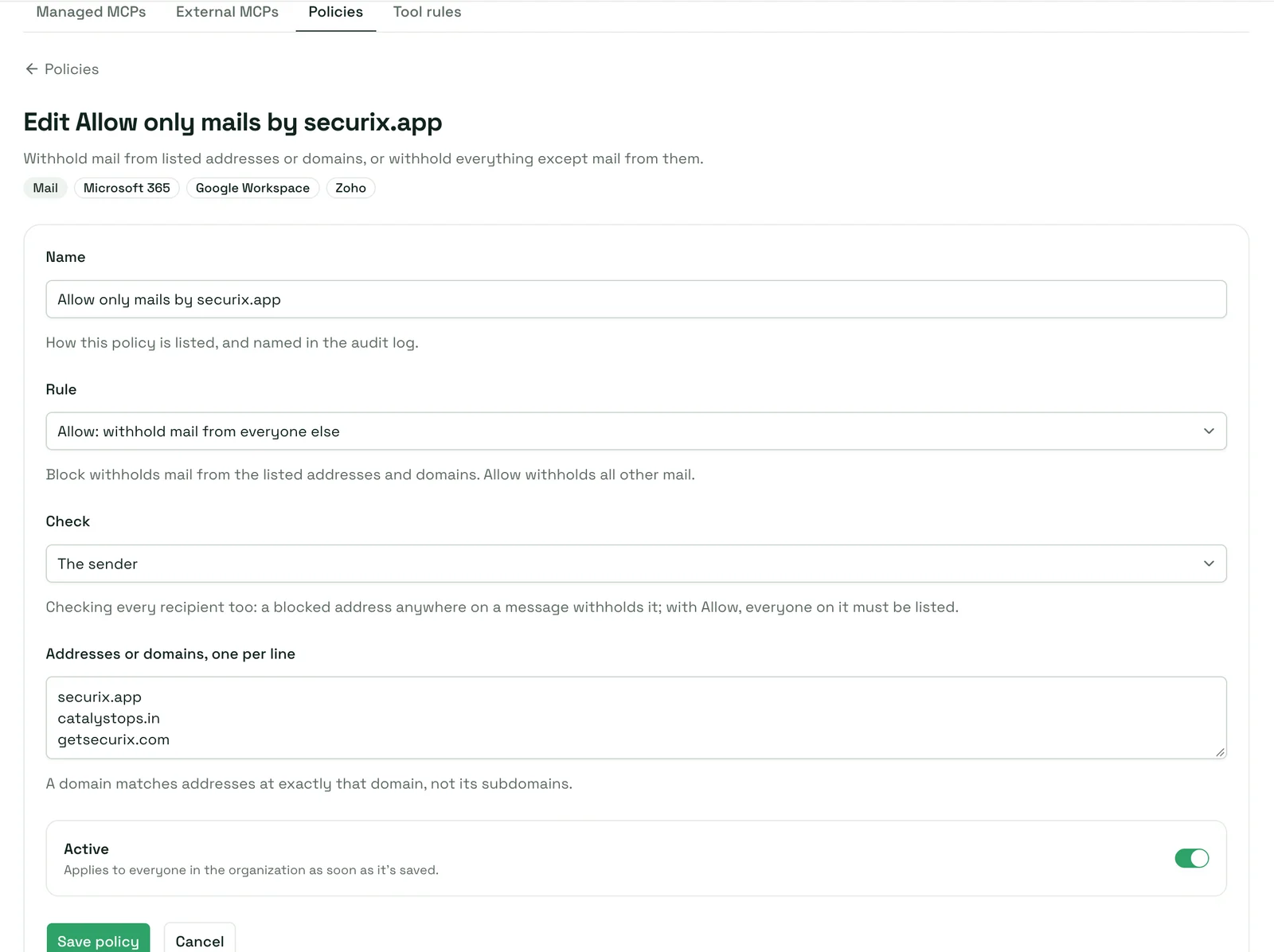

What you get
The controls the MCP ecosystem is missing, as defaults.
Authentication handled for you
Agents connect through a governed MCP URL with SSO identity attribution, so an unauthenticated provider never means an unauthenticated agent.
Policy as code
OPA Rego policy is deterministic. A hallucinating or injected agent still cannot exceed what policy allows.
Least-privilege tools
An agent gets only the exact tools and actions you granted. It cannot reach files, hosts, or resources outside its policy.
DLP both ways
Sensitive data is redacted on the request and on the tool response, before the model processes it.
Audit trail
Every call is attributed to an identity: who ran which tool, how it ended, and which policy or data-protection decision applied. Arguments and results are never recorded.
Kill switch
Sever any agent connection from one dashboard. No per-provider logins and no scattered logs.
In the product
Every tool call, and the decision behind it.
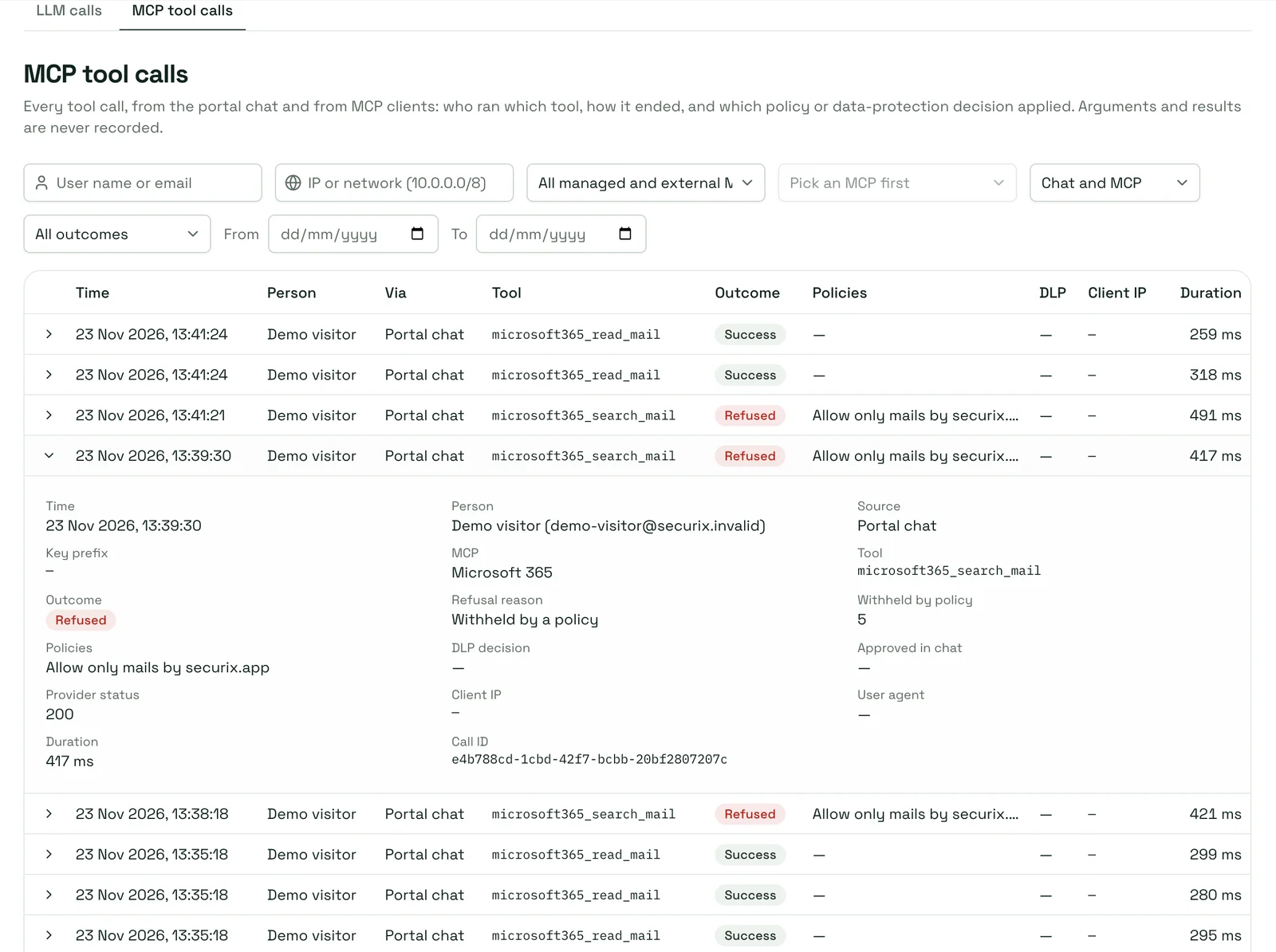
Screenshots are from the SecuriX public demo instance.
How it works
From SSO to your first governed request in under a day.
- STEP 1
Connect identity
Point SecuriX at your identity provider for SSO, so every tool call is attributed to a real person or agent.
- STEP 2
Choose managed MCP servers
Enable managed MCPs such as Microsoft 365 or Gmail, or add external MCPs, all behind a governed SecuriX MCP URL.
- STEP 3
Write policy
Set request and response policy per team, per user, or per request attribute, as granular as your organization needs.
- STEP 4
Point agents at the URL
Agents connect to your SecuriX MCP endpoint. Deploy on-prem or in your VPC with a single docker run.
One flat price
$495/ month per deployment, billed annually ($5,940/year)
No fee per employee, no usage metering, no markup on tokens. The LLM gateway, the MCP gateway, DLP, and audit are all in the one plan.
See pricing →Before you ask
Frequently asked questions
What is an MCP gateway?
An MCP gateway is a control point between AI agents and the tools they call over the Model Context Protocol. It authenticates the caller, applies policy to each tool call, and records what happened, instead of letting agents talk to tool servers directly.
What is a managed MCP server?
A managed MCP server is one SecuriX operates for you, such as Microsoft 365 or Gmail. Because SecuriX runs the server itself, authentication, policy, DLP, and audit are part of the connection rather than something added around it.
What do request and response policies mean?
Request policy decides whether a tool call is allowed before it runs, based on who is calling and what is being asked. Response policy applies to what the tool returns, including redacting sensitive data, before the model sees it.
Does this stop prompt injection?
No policy engine can detect every injection. What it does is make the outcome bounded: because policy is deterministic, an injected or hallucinating agent still cannot call tools or reach data outside what policy allows, and the attempt is logged.
Where does it run?
On-prem or in your own VPC with Docker, with the same policies either way. The MCP gateway is part of the one SecuriX plan alongside the LLM gateway.
How is it priced?
One flat licence per deployment, billed annually, with no per-seat fees and no usage metering. See the pricing page for the current figure.
Key terms: MCP gateway · Model Context Protocol · Managed MCP server · Policy as code · Prompt injection · AI trust layer
See governed MCP in action.
We will walk through managed MCP servers, request and response policy, and the audit trail using your identity provider and your use cases.