- Published on
The OWASP MCP Top 10, Explained for Enterprise Teams
By Subramanyan Balakrishnan · Chief Executive Officer · LinkedIn
The Model Context Protocol lets AI agents call tools, and every tool an agent can call is a way into the systems behind it. OWASP has begun publishing an MCP Top 10 to catalogue the most important risks. This post summarizes the ten in plain language, adds our own view of the controls that help, and is honest about what a gateway cannot do.
Status note. The OWASP MCP Top 10 is a living document. At the time of writing, its page marks it as being in beta release and pilot testing, with entries labelled for the 2025 edition. Names, numbering and wording may change, so treat the official OWASP page as the source of truth. The descriptions and the control mapping below are our own commentary.
The ten risks at a glance
| # | Risk (OWASP name) | What it means in practice | What helps | Can a gateway help? |
|---|---|---|---|---|
| MCP01 | Token Mismanagement & Secret Exposure | Credentials end up hard-coded, long-lived, or leaking through logs and model context | Short-lived scoped tokens, secrets kept out of prompts and logs, redaction of keys | Partly: redaction and central token handling |
| MCP02 | Privilege Escalation via Scope Creep | Permissions granted for a task quietly grow and are never reduced | Least privilege per tool, regular review of grants | Yes: per-tool policy |
| MCP03 | Tool Poisoning | A tool or its output is manipulated to mislead the model | Vetting and pinning tools, validating outputs | Partly: curated servers and response policy |
| MCP04 | Software Supply Chain Attacks & Dependency Tampering | A compromised package or connector changes agent behaviour | Dependency pinning, using vetted servers | Partly: managed servers reduce exposure |
| MCP05 | Command Injection & Execution | An agent runs commands or code built from untrusted input | Input validation and sandboxing at the server | Partly: request policy can constrain calls |
| MCP06 | Prompt Injection via Contextual Payloads | Malicious text in context steers the model | Bounding what any agent can do, human review for risky actions | Partly: limits the blast radius |
| MCP07 | Insufficient Authentication & Authorization | Servers or tools do not verify who is calling | SSO identity, per-call authorization | Yes |
| MCP08 | Lack of Audit and Telemetry | Not enough logging to investigate an incident | Immutable, attributed audit trail | Yes |
| MCP09 | Shadow MCP Servers | Unapproved MCP servers run outside governance | Inventory, discovery, a sanctioned route | Partly: gives a sanctioned path but cannot find rogue servers alone |
| MCP10 | Context Injection & Over-Sharing | Shared or persistent context leaks one task's data into another | Scoping context per user and task | Partly: response policy and DLP |
What each risk means for your deployment
Credentials and privilege (MCP01, MCP02, MCP07)
The three risks about secrets, scope and authentication are the most directly controllable. Agents should authenticate as a real identity, hold only the tools they need, and never have long-lived secrets in their context. A study of 9,695 MCP servers by Trend AI Security found 2,054 with no authentication at all, which we discuss in MCP You Can Trust. A gateway that terminates authentication through SSO, applies least-privilege policy to each tool call, and redacts credentials in traffic addresses much of this. See Zero Trust for AI.
Poisoned and compromised tools (MCP03, MCP04)
If the tool or its package is malicious, no policy in front of it can fully fix that. The strongest defence is to choose what you connect to: use servers that are operated and vetted rather than pulling arbitrary ones from public directories. That is the reasoning behind SecuriX's managed MCP servers, where SecuriX runs the server rather than proxying one of unknown quality. A response policy adds a second check on what the tool returns.
Injection (MCP05, MCP06)
Prompt injection and command injection cannot be eliminated by a filter. What you can do is make the outcome bounded: when policy is deterministic, an injected agent still cannot call tools or reach data outside what policy allows, and the attempt is logged. Request-level policy that constrains which tools and actions are available matters more here than trying to detect every bad prompt.
Visibility and sprawl (MCP08, MCP09)
Audit is a gateway's strongest suit: every tool call, attributed to an identity, with the decision recorded.
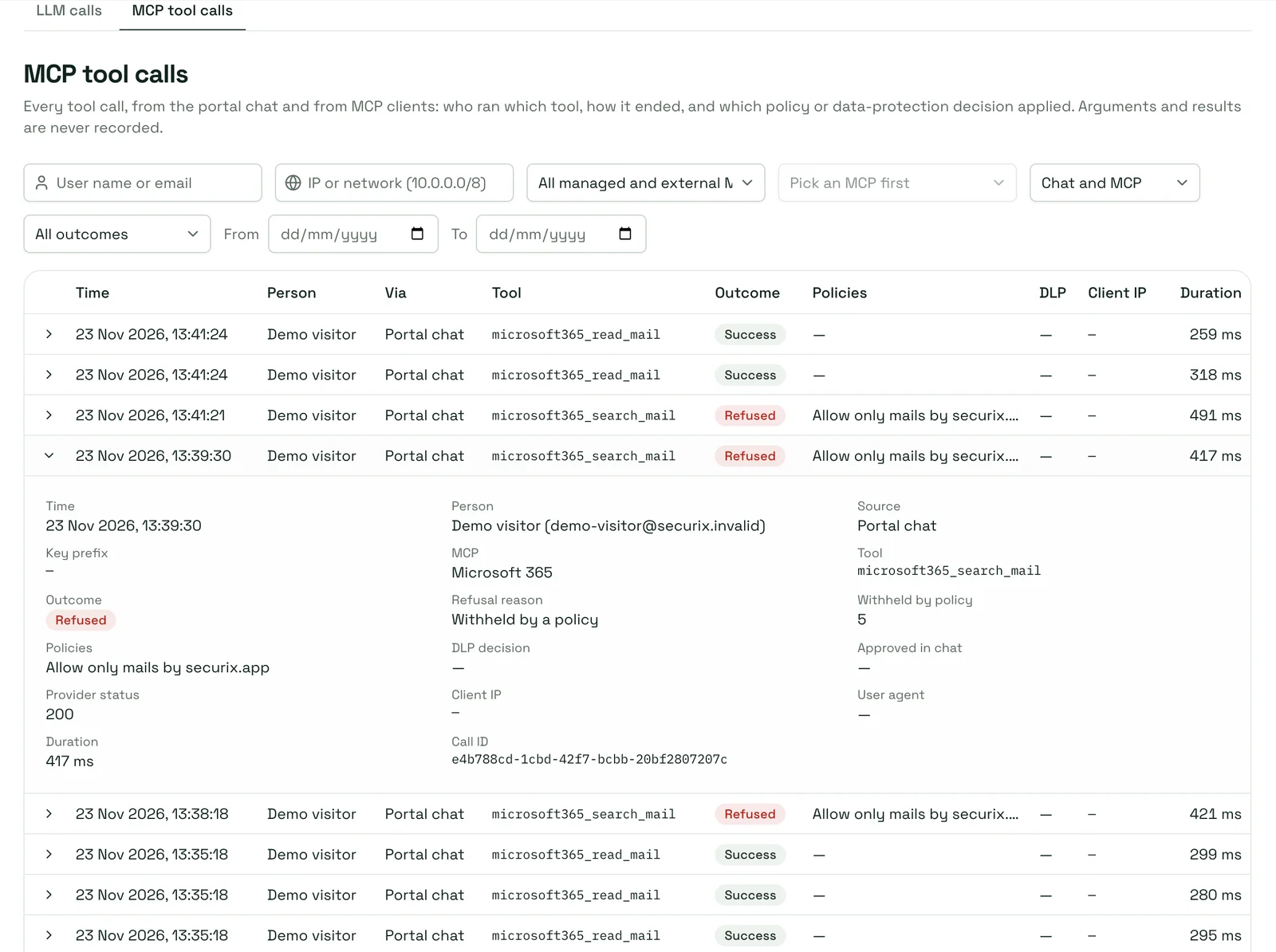
The MCP tool-call audit log in SecuriX: who ran which tool, how it ended, and which policy applied. Arguments and results are never recorded. Shadow servers are different. A gateway gives people a sanctioned, governed route, which reduces the reason to go around it, but finding servers that already exist outside it needs discovery work on your network and endpoints.
Over-sharing (MCP10)
Context that is shared too widely leaks data between users or tasks. Response policy and DLP help by controlling what comes back from a tool before the model sees it. Scoping context per user and per task is also a design choice in how your agents are built.
A practical order of work
- Inventory which MCP servers and tools agents can reach today, including ones nobody approved.
- Put authentication in front of everything and tie calls to identities.
- Apply least privilege per team and per tool, and remove standing access.
- Add policy on responses so sensitive data is redacted before the model sees it.
- Turn on audit and decide who reviews it.
- Choose servers deliberately, preferring managed or vetted ones.
Where SecuriX fits
SecuriX's MCP gateway runs managed MCP servers and enforces policy on every request and every response, with SSO attribution, DLP and an audit trail. It reduces several of these risks directly. It is not a complete answer to all ten, and we would be wary of anyone who says theirs is.
Frequently asked questions
Is the OWASP MCP Top 10 final? No. OWASP describes it as a living document that is still in beta, so check the official page for current wording.
Which risks are easiest to fix? Authentication, scope and audit, because they are controllable with identity and policy. Supply chain and shadow servers take more than a gateway.
Does a gateway stop prompt injection? It cannot detect every injection. It can limit what an injected agent is able to do.
Map these risks to your own agents
We will walk through your MCP use cases and show which controls apply to each.
See SecuriX in front of your own traffic.
Tell us where to reach you and we'll set up a walkthrough with your identity provider, your policies, and your budget structure.